









Introduction
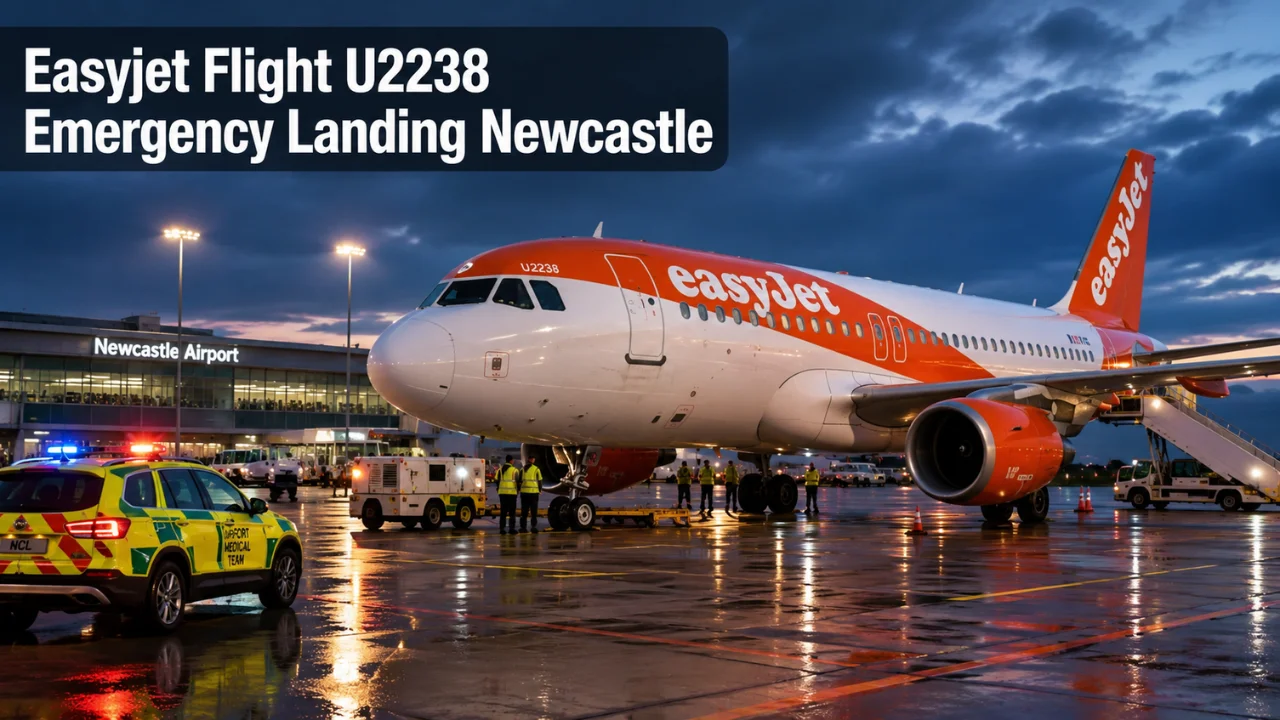
An easyJet flight travelling from Copenhagen to Manchester was diverted to Newcastle after a passenger required urgent medical attention during the journey. The incident took place on October 27, 2025, and quickly attracted attention because the aircraft made an unexpected landing at Newcastle Airport before continuing to its original destination.
The easyjet flight u2238 emergency landing newcastle incident is sometimes described using slightly different flight numbers. The flight involved was officially identified by aviation sources as U22238 and EZY2238. This distinction is important because the shorter U2238 wording appears in some searches and flight references, even though U22238/EZY2238 is the designation associated with the Copenhagen-to-Manchester service involved in the October 2025 diversion.
The available information indicates that the situation was caused by a passenger welfare or medical emergency rather than a reported major mechanical failure. After landing at Newcastle, medical services attended the passenger, and the aircraft later continued toward Manchester.
What Happened to the EasyJet Flight?
The flight was operating from Copenhagen Airport in Denmark to Manchester Airport in England on October 27, 2025. It was a scheduled international service and was expected to complete the journey normally.
During the flight, however, a passenger developed a medical problem that required urgent attention. Instead of continuing to Manchester, the crew decided to divert the aircraft to Newcastle Airport.
The decision meant the aircraft could reach suitable emergency services sooner than it would have by continuing to Manchester. The aircraft subsequently landed safely at Newcastle, where medical personnel were available to assist the passenger.
For passengers on board, the unexpected diversion would have meant a delay and an unplanned stop. However, the primary reason for the landing was passenger welfare rather than a reported aircraft accident.
Why Was the Flight Diverted to Newcastle?
The main reason for the diversion was a medical or welfare situation involving a passenger.
Airline crews are trained to respond to medical problems that occur during flights. When a passenger needs urgent care that cannot reasonably wait until the scheduled destination, pilots can consider diverting to another suitable airport.
Several factors can influence such a decision. These can include the aircraft’s position, available airports, weather conditions, fuel requirements, runway suitability and the availability of emergency services.
In this case, Newcastle offered an appropriate location for the aircraft to land and for the passenger to receive medical assistance. The easyjet flight u2238 emergency landing newcastle incident therefore involved an emergency diversion made for passenger safety.
Was There a Problem With the Aircraft?
There is no confirmed information indicating that the aircraft suffered a major mechanical failure during the incident.
The reported reason for the diversion was a passenger requiring urgent medical attention. This distinction is important because the phrase “emergency landing” can sometimes lead readers to assume that an aircraft had suffered an engine problem, fire or other serious technical failure.
That was not the reported cause in this case.
The aircraft was able to land at Newcastle and later continue its journey toward Manchester. The fact that the flight resumed after the diversion is also consistent with reports that the passenger welfare situation, rather than a major aircraft defect, was behind the unexpected landing.
Understanding the Flight Number U2238 and U22238
One of the most confusing aspects of this story is the flight number.
People searching for the easyjet flight u2238 emergency landing newcastle incident may encounter U2238, U22238 or EZY2238 in different sources. For the particular Copenhagen-to-Manchester flight involved in the October 27, 2025 event, U22238 and EZY2238 are the more precise identifiers.
Flight-tracking services currently identify U22238/EZY2238 as an easyJet service operating between Copenhagen and Manchester. easyJet’s own flight-tracking system also identifies EZY2238 as the Copenhagen-to-Manchester service.
This means writers should avoid presenting the shorter U2238 designation as though there is no distinction. At the same time, the exact search phrase “easyjet flight u2238 emergency landing newcastle” can be used naturally when discussing what people were searching for after the incident.
When Did the Newcastle Diversion Take Place?
The incident occurred on October 27, 2025.
The aircraft had departed Copenhagen and was travelling toward Manchester when the medical situation developed. The diversion took the aircraft away from its scheduled route and toward Newcastle.
Reports published around the time of the incident described the aircraft as an Airbus A320-200. Flight-tracking records also associate the U22238/EZY2238 service with Airbus A320 aircraft.
Exact flight times can vary between published sources because scheduled, estimated and actual times are not always identical. For that reason, the safest description is that the aircraft diverted to Newcastle during its Copenhagen-to-Manchester journey on the evening of October 27.
What Happened When the Plane Reached Newcastle?
After the aircraft landed at Newcastle Airport, medical services attended the passenger who needed urgent assistance.
The arrival at Newcastle allowed the medical situation to be handled on the ground rather than requiring the aircraft to continue to Manchester while the passenger still needed immediate attention.
The diversion also required the airline and airport teams to manage the unexpected arrival. Other passengers had to wait while the medical response took place and the aircraft was prepared for the next stage of the journey.
The easyjet flight u2238 emergency landing newcastle event was therefore not the end of the passengers’ journey. The aircraft was subsequently able to continue toward Manchester.
Did the Flight Continue to Manchester?
Yes. The aircraft eventually continued to Manchester after the diversion.
This is an important detail because an emergency diversion does not necessarily mean that a flight has been cancelled. In many cases, once the immediate reason for the diversion has been dealt with and the aircraft is cleared to continue, passengers can resume their journey.
In the Newcastle incident, the aircraft departed again after the unscheduled stop and completed the journey to Manchester.
Passengers therefore experienced an interruption and delay, but the original destination remained Manchester.
Why Would a Pilot Choose an Alternate Airport?
A pilot may divert an aircraft when continuing toward the planned destination is no longer the best option for safety or passenger welfare.
A medical emergency is one of the situations that can lead to such a decision. The crew has to consider how quickly the passenger needs professional treatment and which suitable airport can provide the necessary support.
The nearest airport is not always automatically selected. Operational factors also matter. An airport must be able to accommodate the aircraft, and suitable emergency arrangements need to be available.
Newcastle was a practical choice for this flight because it provided an airport where the aircraft could land and medical services could respond.
What Does an Emergency Squawk Mean?
Reports about the incident also referred to the use of the emergency transponder code 7700.
Squawk 7700 is an internationally recognized aviation code used to indicate a general emergency to air traffic controllers. When an aircraft transmits this code, controllers know that the crew requires attention and can coordinate an appropriate response.
The use of an emergency code should not automatically be interpreted as meaning that an aircraft is about to crash. Emergencies can have different causes, including medical situations involving passengers.
In this incident, the emergency response was associated with the passenger welfare situation that resulted in the diversion to Newcastle.
How Medical Emergencies Are Handled During Flights
A medical problem can become more difficult to manage when an aircraft is several thousand feet above the ground and far from hospital facilities.
Cabin crew members can provide initial assistance and communicate with the pilots about the passenger’s condition. Depending on the circumstances, the crew may also seek medical advice while the aircraft is in the air.
The pilots then have to assess the available options. If landing sooner would provide a significant safety benefit, diverting to another airport may be the most appropriate course of action.
This type of decision is focused on reducing the time between a medical emergency occurring and the passenger reaching professional medical care.
Did Newcastle Airport Handle the Emergency?
Newcastle Airport became the temporary destination for the flight after the diversion decision was made.
Once the aircraft arrived, medical services were available to respond to the passenger’s condition. The aircraft was then able to remain on the ground while the immediate situation was addressed.
The successful handling of the arrival demonstrates why airports maintain emergency response arrangements. An unexpected diversion can happen for many reasons, and airports need to be capable of receiving aircraft that require urgent assistance.
Was the Landing Dangerous?
The available reporting does not indicate that the aircraft crashed or suffered a catastrophic landing.
Calling the event an “emergency landing” describes the urgent nature of the diversion, but it should not be confused with an aircraft crash or an uncontrolled landing.
The aircraft reached Newcastle safely and later continued to Manchester. The reported emergency was related to a passenger medical situation rather than a confirmed catastrophic aircraft problem.
For readers searching for the easyjet flight u2238 emergency landing newcastle story, this is one of the most important distinctions to understand.
What Passengers Experienced During the Diversion
Passengers travelling from Copenhagen to Manchester would have experienced an unexpected change to their journey.
Instead of landing directly at Manchester, the aircraft first travelled to Newcastle. The additional landing and time on the ground naturally caused a delay compared with the original schedule.
However, diversions are safety decisions, and passengers generally have to accept some disruption when an urgent situation occurs onboard.
In this case, the diversion gave the affected passenger access to medical services while allowing the remaining passengers to continue their journey afterward.
Key Facts About the Incident
The main confirmed details can be summarized as follows:
- The incident occurred on October 27, 2025.
- The flight was an easyJet service from Copenhagen to Manchester.
- The flight is identified by aviation sources as U22238 and EZY2238.
- The aircraft diverted to Newcastle Airport.
- The diversion was caused by a passenger welfare or medical emergency.
- Medical services met the affected passenger after the aircraft landed.
- The aircraft was able to continue toward Manchester afterward.
- There is no confirmed indication that a major mechanical failure caused the diversion.
- Reports identified the aircraft as an Airbus A320-200.
- The flight number can appear differently across search and aviation platforms.
These facts provide a clearer picture of what happened than the phrase “emergency landing” alone.
Why the Incident Attracted Attention
Flight diversions naturally attract attention because passengers and people monitoring aircraft can see an unexpected change in route.
The use of an emergency transponder code can also make an incident appear more serious when viewed through flight-tracking websites. However, the reason behind the emergency is essential to understanding what actually happened.
In this case, the passenger medical situation was the central issue. The aircraft landed safely at Newcastle, medical services responded, and the journey continued.
The easyjet flight u2238 emergency landing newcastle search term therefore refers to an event that was serious enough to require an urgent diversion but did not result in a reported aircraft disaster.
Final Outcome for the Flight
The flight ultimately continued to Manchester after the Newcastle diversion.
For the affected passenger, the unexpected landing provided access to medical assistance. For the other passengers, it meant additional time and an unavoidable delay before reaching Manchester.
The incident also demonstrates how quickly an ordinary commercial flight can change when a passenger develops a serious medical problem. Pilots, cabin crew, air traffic controllers, airport staff and emergency medical teams all have roles in responding to such situations.
The easyjet flight u2238 emergency landing newcastle incident is best described as an emergency medical diversion from the Copenhagen-to-Manchester route. The available information does not support describing it as a crash, catastrophic aircraft failure or major aviation accident.
Conclusion
The easyjet flight u2238 emergency landing newcastle incident occurred after an easyJet aircraft travelling from Copenhagen to Manchester diverted to Newcastle because a passenger required urgent medical attention.
The aircraft landed safely, medical services responded to the passenger, and the flight later continued to Manchester. Although the wording “emergency landing” may sound alarming, the reported circumstances point to a passenger welfare emergency rather than a major mechanical failure.
There is also an important flight-number clarification. The affected service is more accurately identified as U22238/EZY2238, while U2238 is the shorter form commonly appearing in searches. Keeping this distinction clear helps readers understand the incident without confusing it with other easyJet flight records.
Frequently Asked Questions
1. Why did easyJet flight U2238 land in Newcastle?
The flight diverted to Newcastle because a passenger onboard required urgent medical attention. The diversion allowed the passenger to receive assistance from medical services after landing.
2. Was easyJet flight U2238 travelling to Manchester?
Yes. The affected flight was travelling from Copenhagen to Manchester. Aviation sources identify the service as U22238/EZY2238.
3. Was there a mechanical failure on the aircraft?
There is no confirmed information showing that a major mechanical failure caused the diversion. The reported reason was a passenger medical or welfare emergency.
4. Did the aircraft continue to Manchester after landing in Newcastle?
Yes. After the medical situation was handled at Newcastle, the aircraft continued its journey and reached Manchester.
5. Why do some sources call the flight U2238 while others use U22238 or EZY2238?
Different aviation and flight-tracking systems can display airline flight identifiers in different formats. For this particular Copenhagen-to-Manchester service, U22238 and EZY2238 are the more precise identifiers associated with the incident.