







Introduction
The Danish word fascisterne means “the fascists.” It is the definite plural form of the word fascist and is used when referring to people who support or belong to a fascist movement. The underlying term fascist refers to a supporter of fascism.
Understanding fascisterne requires looking at the history of fascism itself. Fascism became one of the most important and destructive political movements in 20th-century Europe. It developed during a period marked by political instability, economic difficulties, social conflict, and dissatisfaction with established political systems.
The word is therefore closely connected with the history of authoritarian politics, nationalism, political repression, propaganda, and the decline of democratic institutions in several European countries.
What Does Fascisterne Mean?
Fascisterne is a Danish noun meaning “the fascists.” The singular form, fascist, describes a person who supports fascism. The Danish Dictionary defines a fascist as a supporter of fascism and also records a broader use for a person associated with strongly nationalist and authoritarian ideas.
The meaning is most precise when the word is used in its historical context. Fascists were not simply people who supported strong government or national pride. Historical fascist movements generally rejected democratic pluralism and promoted authoritarian political structures.
Because the word has also developed a broader meaning in everyday political language, it is important to distinguish its historical definition from casual modern usage.
What Is Fascism?
Fascism is an authoritarian political movement and ideology that places strong emphasis on the state, national unity, centralized authority, and obedience to leadership. The Danish Dictionary describes fascism as a political movement that places the state and people above the individual and uses dictatorial methods to set aside democracy. It identifies Italy, Germany, and Spain as important settings for fascist or related movements during the interwar period.
Fascism developed in different forms, so there was no single political program followed identically by every fascist organization. However, several common characteristics can be found across historical examples.
These included opposition to liberal democracy, hostility toward political opponents, strong nationalism, mass political organization, propaganda, political violence, and concentration of power around an authoritarian leader.
Where Did Modern Fascism Begin?
Modern fascism is most strongly associated with Italy after the First World War. The term itself has Italian origins and is connected to fascio, meaning a bundle or group, as well as the Latin fasces, an ancient Roman symbol of authority.
Italy faced serious political and economic difficulties following the First World War. Social tensions increased, and political conflict became particularly intense. In this environment, Benito Mussolini and his followers built a movement that promised national strength, order, and political transformation.
The Italian Fascist movement gradually expanded its influence and became a major political force.
The Rise of Fascism in Italy
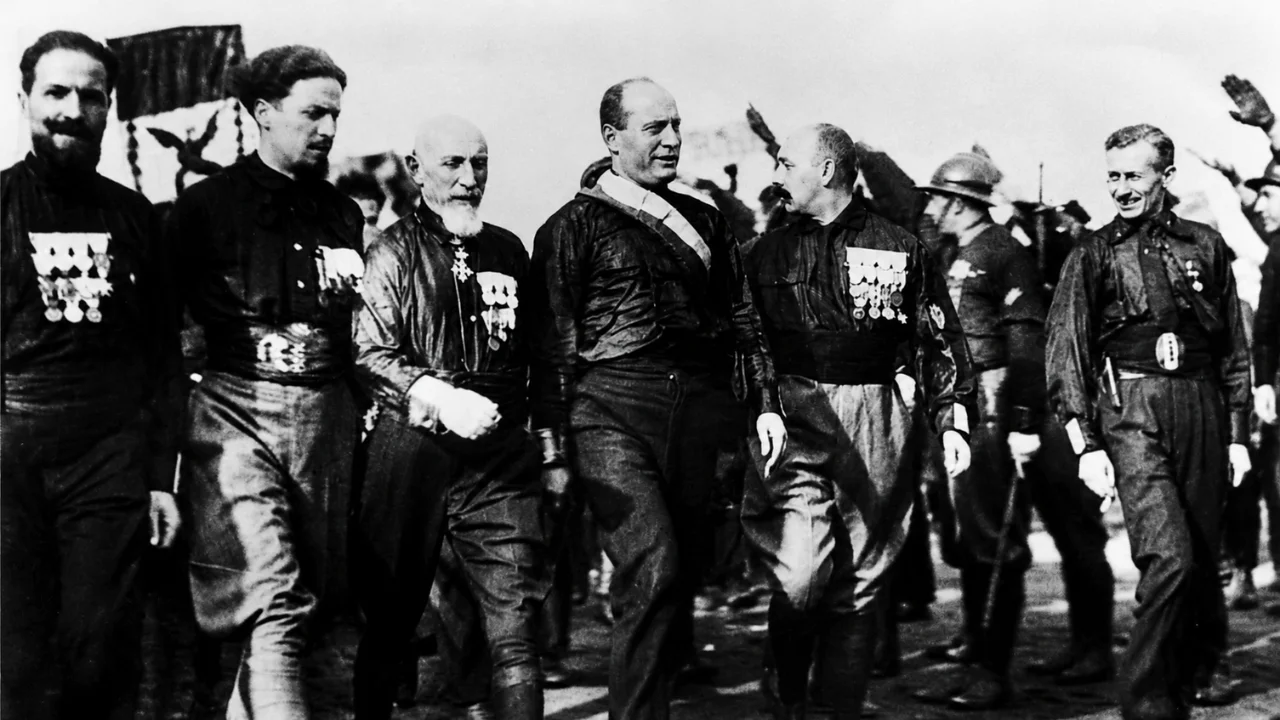
The history of fascisterne is closely connected with Benito Mussolini and the Italian Fascist movement. Mussolini’s movement gained strength during the early 1920s, using political organization, public demonstrations, intimidation, and violence against opponents.
A major turning point came in October 1922 with the March on Rome. Fascist forces mobilized and placed pressure on the Italian government. King Victor Emmanuel III ultimately appointed Mussolini as prime minister, allowing him to enter government.
Mussolini did not immediately create the fully developed dictatorship that later emerged. The transformation took place over several years as democratic institutions were weakened, opposition was restricted, and political power became increasingly concentrated around Mussolini and the Fascist Party.
This gradual consolidation is important because the rise of fascism was not simply a single event. It involved political decisions, institutional weaknesses, organized pressure, and the gradual removal of democratic restraints.
How Fascist Rule Changed Italian Politics
Once Mussolini and the Fascist Party gained power, Italian political life changed substantially. Opposition groups faced increasing restrictions, while the government worked to strengthen its authority.
Fascist political culture emphasized discipline, national unity, loyalty, and obedience. Public ceremonies, political organizations, newspapers, and other forms of communication were used to promote the regime’s message.
The Fascist government also sought to influence education and youth organizations. The goal was to create loyalty to the state and the Fascist system from an early age.
Political repression became an important part of the regime. Independent political activity was increasingly restricted, and opponents faced intimidation and persecution.
Fascism and Germany
Germany became another major center of authoritarian and fascist politics during the interwar period. The Nazi movement, led by Adolf Hitler, shared several characteristics with European fascist movements, including authoritarian leadership, extreme nationalism, mass political mobilization, propaganda, militarism, and rejection of democratic opposition.
At the same time, Nazism had its own defining characteristics, particularly its extreme racial ideology and antisemitism. The Nazi regime built a dictatorship after Hitler became chancellor in 1933 and eventually carried out systematic persecution and mass murder.
For that reason, it is useful to recognize both the similarities and differences between Italian Fascism and German National Socialism. Treating every fascist or authoritarian movement as identical can make the historical picture less accurate.
Fascisterne and Fascist Movements in Denmark
The history of fascisterne was not limited to Italy and Germany. Fascist ideas also appeared in Denmark during the interwar period.
Danish fascist and fascist-influenced organizations remained much smaller than the major movements that gained state power elsewhere in Europe. Their political influence was limited, and Denmark did not develop a fascist dictatorship comparable to Mussolini’s Italy or Hitler’s Germany.
Nevertheless, the presence of such organizations shows that the political ideas spreading through Europe after the First World War also reached Denmark.
Studying Danish fascism is useful because it demonstrates that fascism did not have exactly the same political strength or social influence in every European country.
Why the Interwar Period Was Important
The years between the First and Second World Wars created conditions in which authoritarian movements could attract support.
Europe was dealing with economic instability, unemployment, political polarization, social unrest, and fears about communism. Many people had also become disillusioned with traditional political institutions after the destruction and upheaval of the First World War.
Fascist movements presented themselves as forces capable of restoring order and national confidence. They criticized parliamentary politics and portrayed political disagreement as a threat to national unity.
This combination of social uncertainty and political polarization helped create opportunities for authoritarian movements.
The Role of Propaganda
Propaganda played a major role in fascist politics. Fascist governments and organizations used newspapers, posters, radio, speeches, public ceremonies, political rallies, and educational institutions to communicate their ideas.
The purpose was not simply to promote a political party. Propaganda could shape public perceptions of national identity, political opponents, social groups, and government policy.
Fascist propaganda often presented the nation as a unified community and portrayed political opponents as enemies of that unity. Repetition of political messages helped create a controlled public narrative.
The use of propaganda is one reason the history of fascisterne remains relevant when studying the relationship between political communication and public opinion.
Fascism and Political Repression
Political repression was another major characteristic of fascist rule. Fascist governments sought to reduce or eliminate organized opposition and limit institutions that could challenge state authority.
Opposition parties, independent organizations, journalists, and political activists could face restrictions or persecution. The political system was gradually transformed so that meaningful opposition became increasingly difficult.
This separation between democratic politics and fascist government is important. Fascism did not simply represent a different political opinion. Its historical movements sought to transform political systems in ways that reduced democratic competition and concentrated authority.
Fascism and the Spanish Civil War
The Spanish Civil War, which began in 1936, became another important episode in the history of European authoritarian and fascist movements.
Francisco Franco’s forces received military assistance from Fascist Italy and Nazi Germany. The conflict therefore became connected to the broader ideological struggle taking place across Europe.
The Spanish Civil War also attracted international attention because it represented a confrontation between opposing political visions during a period of growing international tension.
Its importance goes beyond Spain itself because the conflict demonstrated how European political divisions were becoming increasingly connected to military intervention and international ideological conflict.
The Historical Impact of Fascism
The consequences of fascist and related authoritarian movements were profound. Democratic institutions were weakened or destroyed, political opponents were persecuted, and aggressive nationalism contributed to international conflict.
The Nazi regime’s racial ideology resulted in systematic persecution and the Holocaust, while the wider expansionist policies of Nazi Germany helped lead Europe into the Second World War.
Italian Fascism also pursued authoritarian rule and imperial expansion. These developments demonstrate that the history of fascism cannot be separated from questions about political power, violence, discrimination, war, and human rights.
Why the Meaning of Fascisterne Matters Today
The term fascisterne continues to appear in historical discussions and political language. Its historical meaning, however, should remain clear.
Fascism is more specific than simply being authoritarian, conservative, nationalist, or supportive of a strong government. Historians examine a combination of characteristics when studying whether a political movement belongs to the fascist tradition.
These characteristics can include extreme nationalism, rejection of democratic pluralism, authoritarian leadership, mass mobilization, political repression, glorification of violence, and efforts to create a highly controlled political society.
Using the term carefully helps prevent historical concepts from becoming vague political labels.
The Lessons of Fascist History
The history of fascisterne offers important lessons about how democratic institutions can become vulnerable.
Democracy depends on elections, but it also requires independent institutions, political competition, freedom of expression, legal protections, and the ability to criticize those in power.
The European experience of the 20th century demonstrates that democratic systems can face serious pressure when political divisions become extreme and institutions fail to resist authoritarian movements.
Studying this history can therefore help readers understand why political institutions, historical evidence, and responsible public discussion matter.
Conclusion
The word fascisterne means “the fascists” in Danish and refers to people who support or belong to fascist movements. Its historical meaning is closely connected with the development of fascism in Europe during the 20th century.
Modern fascism first became a major political force in Italy, where Benito Mussolini and the Fascist movement rose to power in 1922. Fascist and related authoritarian movements later gained influence elsewhere, most notably in Germany. Denmark also experienced smaller fascist movements during the interwar period, although they never achieved the same political dominance.
The history of fascisterne is ultimately a history of authoritarianism, nationalism, political organization, propaganda, repression, and the struggle between democratic institutions and concentrated political power. Understanding these historical developments provides important context for one of the most significant political movements of modern European history.
Frequently Asked Questions
1. What does fascisterne mean in Danish?
Fascisterne means “the fascists” in Danish. It is the definite plural form of fascist, referring to people who support or belong to fascist movements.
2. What is the historical meaning of fascism?
Fascism is an authoritarian political ideology associated with strong nationalism, centralized leadership, rejection of democratic pluralism, political repression, and the prioritization of the state or national community over individual political freedoms.
3. Where did fascism become a major political movement?
Italy was the first country where modern fascism became a major political force and gained national government power. Benito Mussolini became prime minister in 1922, after which the Fascist system was progressively consolidated.
4. Did fascist movements exist in Denmark?
Yes. Fascist and fascist-influenced organizations existed in Denmark during the interwar period, although they remained relatively small and never established a dictatorship comparable to those created in Italy or Germany.
5. Why is the history of fascisterne important?
The history of fascisterne helps explain the development of fascism, authoritarian government, political repression, propaganda, and the weakening of democratic institutions in 20th-century Europe. It also provides important historical context for understanding the political conflicts that shaped the period.
Read More: Bikesly: E-Bike Models, Features, Specs, Range and Buying Guide